
Planning Kedarnath Yatra 2026? The two questions every pilgrim asks first are: what is the Kedarnath weather right now, and is the road open? These are not just convenience questions — they are safety questions. Kedarnath weather at 3,583 metres changes without warning. Clear skies at Gaurikund can turn into hailstorms within an hour above Linchauli. And Kedarnath road status on the Rishikesh-Sonprayag highway decides whether your yatra begins on schedule or ends in an unplanned wait at a roadside dharmshala.
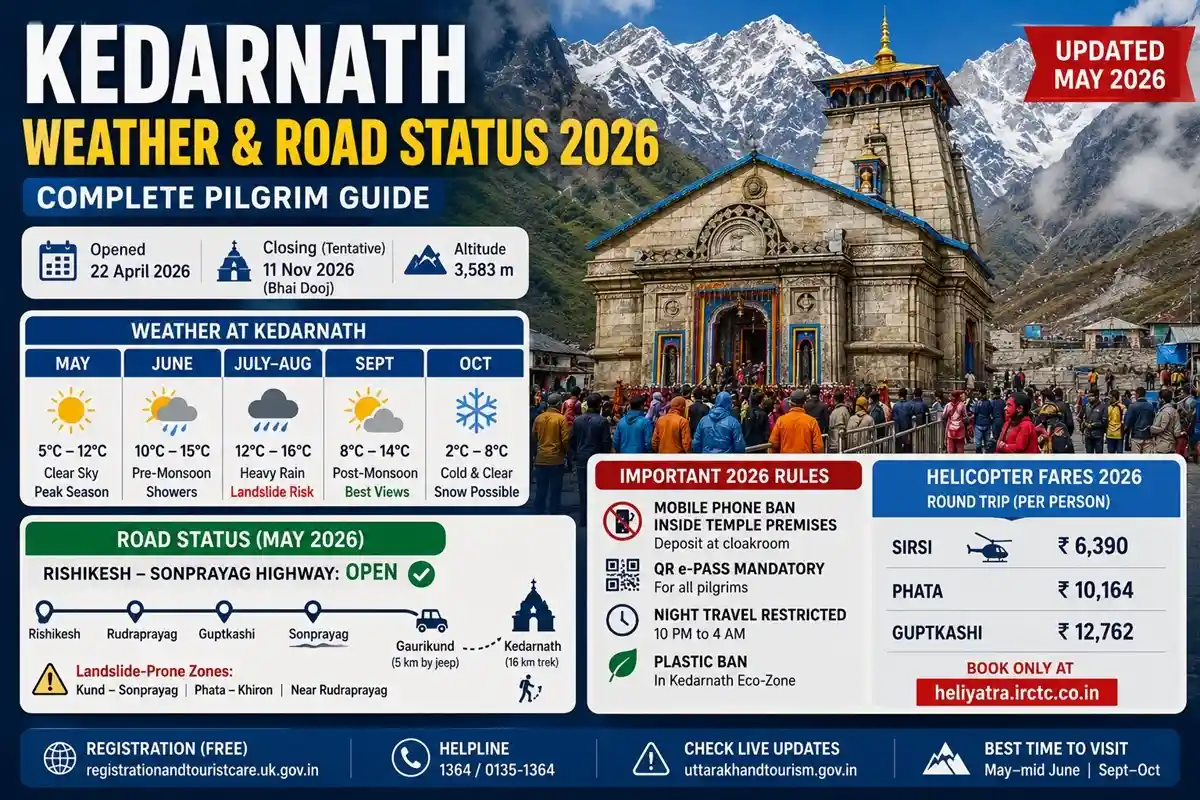
Kedarnath Dham — one of the 12 Jyotirlingas, managed by the Badrinath-Kedarnath Temple Committee (BKTC) — opened for 2026 on 22 April 2026 at 8:00 AM. The temple is expected to close on 11 November 2026 (Bhai Dooj), though the final closing date will be announced on Vijayadashami. The 2026 season has already introduced two major new rules: a complete mobile phone ban inside the temple premises, and mandatory QR-code e-pass verification at checkposts.
This guide is written from the ground up for Kedarnath 2026 — with correct opening dates, accurate helicopter fares, the right registration portal, weather data, and everything else a pilgrim needs to plan a safe and meaningful yatra.
Quick Overview |
Key Takeaways — Kedarnath 2026
|
Important New Rules for Kedarnath Yatra 2026
2026 New Rules — Read Before You Go
|
Kedarnath Weather 2026 — Month by Month
Kedarnath weather is one of the most important planning factors for your yatra. Sitting at 3,583 metres in the Garhwal Himalayas, the climate changes dramatically with each season — and even within a single day. Here is what to expect each month.
May — Peak Season, Cold Nights, Best Views
May is the most popular month for Kedarnath Yatra, and with good reason. The temple opens on 22 April, so May sees the first full month of pilgrimage. Daytime temperatures at the temple hover between 5°C and 12°C, while nights drop sharply to -2°C or colder in early May. Snow from winter still covers the peaks around Kedarnath and may linger on sections of the trail above Linchauli.
Most pilgrims prefer May for the clearest mountain views — Kedarnath peak and the Chorabari glacier are spectacular without monsoon cloud cover. Morning darshan is better because skies are consistently clear before noon; fog and clouds build up in the afternoon. Book hotels at Guptkashi, Phata, and Sonprayag at least 2-3 months in advance — May slots fill up fast, especially around the opening week.
June — Warmer but Pre-Monsoon Clouds Begin
Early June remains excellent. Daytime temperatures rise to 10°C–15°C at the temple, making the trek physically easier. However, pre-monsoon conditions set in from mid-June — expect afternoon showers, building clouds, and occasional thunder. Visibility on the trail is reduced in the afternoons.
During peak season (May to mid-June), the Gaurikund–Kedarnath trail sees 8,000–12,000 pilgrims daily. SDRF personnel and local administration manage crowd flow. Darshan queues can be 2–4 hours long at the temple. Starting your trek by 4–5 AM helps avoid the rush and afternoon weather deterioration.
July–August — Monsoon Season, Genuine Risk
These are the riskiest months. Heavy rainfall causes landslides on the Rishikesh–Rudraprayag–Sonprayag highway, sometimes blocking roads for 12–36 hours. The trail above Gaurikund becomes slippery; rockfalls have been reported near the Bheembali and Linchauli stretches.
| Monsoon Safety Warning (July–August)
If you must travel in monsoon: check real-time road alerts on uttarakhandtourism.gov.in and SDRF Uttarakhand social media before leaving. Never trek in active rain. Keep 2–3 buffer days in your itinerary. The 2013 Kedarnath flood is a reminder — the Mandakini valley’s weather is not to be underestimated. |
September — Best Kept Secret for Pilgrims
September is arguably the most rewarding month to visit Kedarnath, yet it remains underrated. The monsoon withdraws from Uttarakhand around mid-September. From late September, skies are crystal clear, temperatures are crisp and comfortable (8°C–14°C during the day), and crowds thin out significantly after the school-holiday rush.
Local drivers and guides usually recommend September–October as the most comfortable season — roads are clear, the trail is not overcrowded, and the Himalayan panorama after monsoon is the sharpest you will ever see. Hotel prices also ease off from peak-season rates.
October — Last Chance Before Winter Closure
October sees a second rush as pilgrims hurry to complete darshan before the temple closes. Daytime temperatures drop to 2°C–8°C at Kedarnath; nights fall to -5°C or below. Heavy woolens are non-negotiable. Snowfall is possible from late October. The temple closes on Bhai Dooj (11 November 2026 tentative) — the closing ceremony with the Kedarnath Doli procession to Ukhimath is a cultural experience worth witnessing.
Kedarnath Temperature Chart by Month
| Month | Daytime Temp (°C) | Nighttime Temp (°C) | Weather Condition | Crowd Level |
| April (post-22nd) | 3 – 10 | -4 to 1 | Cold, snow on peaks, clear skies | Moderate (opening rush) |
| May | 5 – 12 | -2 to 3 | Clear days, cold nights, minimal rain | Very High |
| June | 10 – 15 | 2 – 7 | Warm days, pre-monsoon showers from mid-June | High |
| July | 12 – 16 | 7 – 10 | Heavy rain, landslide risk on highway/trail | Moderate (risky) |
| August | 12 – 15 | 7 – 9 | Heavy rain continues, trail hazardous | Moderate (risky) |
| September | 8 – 14 | 2 – 6 | Rain reduces; clear from late Sept | Low to Moderate |
| October | 2 – 8 | -5 to 2 | Cold and clear; snowfall possible late Oct | Moderate (rising) |
| Nov (early, closing) | -2 to 4 | -10 to -3 | Heavy snow likely; temple closes Bhai Dooj | Low (closing rush) |
Kedarnath Road Status 2026 — Full Route Guide
Road conditions are the single biggest variable in any Kedarnath Yatra plan. The main motorable route runs: Rishikesh → Devprayag → Srinagar (Garhwal) → Rudraprayag → Tilwara → Agastmuni → Kund → Guptkashi → Sitapur → Sonprayag → Gaurikund (trek start, 16 km to Kedarnath).
Current Road Status (May 2026)
As of May 2026, the Rishikesh–Sonprayag highway is open and motorable. The Sonprayag–Gaurikund stretch (5 km) is also clear and operating with shared jeeps. All checkposts are active — carry your Yatra e-pass and government ID at all times.
Landslide-Prone Zones to Know
The stretches most frequently affected by landslides during monsoon are: the Kund–Sonprayag section along the Mandakini valley, the Phata–Khiron area, and certain points near Rudraprayag where the Alaknanda and Mandakini rivers meet. BRO (Border Roads Organisation) clears blockages, usually within 6–24 hours for minor slides.
Last Motorable Point: Sonprayag
Private vehicles — whether personal cars or hired taxis — are not permitted beyond Sonprayag. From Sonprayag, pilgrims take government-approved shared jeeps to Gaurikund (approximately Rs. 50–100 per person, 5 km, 15–20 minutes). The Kedarnath trek begins at Gaurikund.
How to Track Live Road Status
- Uttarakhand Tourism: uttarakhandtourism.gov.in
- SDRF Uttarakhand on social media (Twitter/X, Facebook) for real-time alerts
- Yatra Registration Portal: registrationandtouristcare.uk.gov.in
- Local Uttarakhand news: Amar Ujala, Dainik Jagran (Uttarakhand editions)
- BKTC Official: badrinath-kedarnath.gov.in
Kedarnath Route Distance Chart 2026
| Route Segment | Distance | Mode | Approx. Time |
| Delhi to Haridwar | 225 km | Train / Bus / Car | 4–6 hrs |
| Haridwar to Rishikesh | 25 km | Bus / Taxi | 45 min |
| Rishikesh to Rudraprayag | 140 km | Bus / Taxi | 4–5 hrs |
| Rudraprayag to Guptkashi | 72 km | Bus / Taxi | 2–3 hrs |
| Guptkashi to Sonprayag | 25 km | Bus / Taxi | 45 min |
| Sonprayag to Gaurikund | 5 km | Shared Jeep / Walk | 15–20 min |
| Gaurikund to Kedarnath (trek) | 16 km | On foot / Horse / Palki | 6–8 hrs (foot) |
| Gaurikund to Kedarnath (heli) | ~7 km aerial | Helicopter (Phata/Sirsi/Guptkashi) | 7–10 min |
Kedarnath Yatra Registration 2026 — Mandatory & Free
The Uttarakhand government has made Chardham Yatra registration mandatory since 2023. In 2026, the system is stricter — QR code e-passes are scanned at every checkpost from Sonprayag onwards. No registration = no entry. And importantly, registration is completely free. If any website or agent charges money for registration, it is a scam.
Official Portal: registrationandtouristcare.uk.gov.in
Mobile App: Tourist Care Uttarakhand (Google Play and App Store)
WhatsApp Registration: Send ‘Yatra’ to +91-8394833833
Helpline: Call 1364 or 0135-1364 for assisted registration
Step-by-Step Registration Process
- Visit registrationandtouristcare.uk.gov.in and sign up with your mobile number (OTP verification).
- Click ‘Create Tour’, select Kedarnath as destination, and choose your travel date.
- Enter personal details for all pilgrims in your group (name, age, gender, ID number). Registration is needed for every person, including children.
- Upload a government-issued photo ID (Aadhaar for Indian nationals; passport for foreign pilgrims).
- Submit and download your QR-coded Yatra e-pass. Also sent via SMS and email.
- Carry printed copy + digital backup. QR is scanned at checkposts — both Sonprayag and trail points.
Booking early is strongly recommended during May–June peak season — daily pilgrim slots are capped by the administration and fill up fast. In 2025, slots for popular May dates were exhausted nearly a month before the yatra date.
Kedarnath Trek: Gaurikund to Kedarnath (16 km)
The 16 km trek from Gaurikund to Kedarnath is the soul of this pilgrimage. It is not technically difficult — there are no ropes or vertical climbs — but it is physically demanding because of continuous elevation gain, altitude (you go from 1,982 m to 3,583 m), and mountain weather. Most healthy pilgrims complete the uphill trek in 6–8 hours.
Trek Route: Stage by Stage
| Stage | Distance | Altitude | Key Facilities |
| Gaurikund (start) | 0 km | 1,982 m | Hot springs, tea stalls, horse/palki booking |
| Jungle Chatti | ~4 km | 2,650 m | Tea, snacks, basic rest, first rest point |
| Bheembali | ~7 km | 3,050 m | GMVN tents, dhabas, medical post, free water |
| Linchauli | ~11 km | 3,250 m | GMVN & private tents, medical, scenic viewpoint |
| Kedarnath Base Camp | ~15 km | 3,550 m | GMVN camps, accommodation |
| Kedarnath Temple | 16 km | 3,583 m | Temple, BKTC guesthouses, GMVN, food stalls |
Horse (Ghoda) and Palki (Doli) Service
Horse and palki services are available from Gaurikund. In 2026, horse rates for one way are approximately Rs. 2,500–4,500, depending on season and demand. Palki rates are Rs. 5,000–9,000 one way and vary by operator. Book at Gaurikund early morning — during peak season, demand significantly exceeds supply. Starting by 5 AM gives you the best chance of securing a horse or palki.
Helicopter Service to Kedarnath 2026 — Corrected Prices
Helicopter service to Kedarnath operates from three helipads: Sirsi (Sersi), Phata, and Guptkashi. The flight takes 7–10 minutes. All tickets must be booked exclusively at heliyatra.irctc.co.in — no other website or agent is authorized.
Official 2026 UCADA-regulated round-trip fares (per person, includes GST and Rs. 300 convenience fee):
| Helipad | Round-Trip Fare (per person) | One-Way Fare | Notes |
| Sirsi (Sersi) | ~Rs. 6,086–6,390 | ~Rs. 3,043 | Cheapest; hardest to book — sells out fastest |
| Phata | ~Rs. 9,680–10,164 | ~Rs. 4,840 | Most popular; good balance of price and availability |
| Guptkashi | ~Rs. 12,154–12,762 | ~Rs. 6,077 | Most expensive; closest to Sonprayag base |
Note: Tickets are sold as round-trips on the official IRCTC portal. Guptkashi slots for May–June sell out within 90 minutes of the booking window opening. Char Dham Yatra registration (e-pass) is mandatory to book helicopter tickets — link your URN from the registration portal.
How to Reach Kedarnath: Transport Options
By Air
Nearest airport: Jolly Grant Airport, Dehradun — approximately 250 km from Sonprayag. IndiGo, Air India, and SpiceJet operate daily flights from Delhi (flight time ~1 hour). From Dehradun airport, take a taxi or ISBT bus to Rishikesh (45 km), then onward by road.
By Train
Haridwar Junction is the best-connected railhead — trains from Delhi, Mumbai, and most major cities. Rishikesh has a small station with limited services. From Haridwar, GMOU/ISBT buses or shared taxis run to Rudraprayag and Sonprayag. Major trains from Delhi: Haridwar Shatabdi, Nanda Devi Express, Mussoorie Express.
By Road
GMOU (Garhwal Motor Owners Union) and ISBT buses operate from Haridwar, Rishikesh, and Dehradun directly to Sonprayag (7–9 hours depending on season traffic). Private taxi from Rishikesh to Sonprayag costs Rs. 5,000–9,000 for a full cab. Shared taxis are available from Rishikesh ISBT to Rudraprayag (Rs. 300–400 per seat) and then Rudraprayag to Sonprayag (Rs. 200–300 per seat).
Accommodation Near Kedarnath: Where to Stay
At Kedarnath Temple (3,583 m)
Accommodation at the temple campus is managed by BKTC and GMVN. Options include GMVN tented camps, GMVN guesthouses, and BKTC dharmshalas. Facilities are basic — shared bathrooms, limited hot water, no room service. Night temperatures can fall below -5°C; request extra blankets. Book GMVN accommodation at gmvnl.com. Availability is extremely limited — book months ahead for May.
At Sonprayag and Gaurikund
Sonprayag has a growing supply of budget guesthouses and mid-range hotels. Families usually choose Sonprayag as the base — it is warmer, better connected, and more comfortable than Gaurikund. Budget rooms: Rs. 600–1,500 per night. Gaurikund has mostly basic lodges and dharmshalas, suitable for trekkers starting the next morning.
At Guptkashi and Phata (Recommended Base)
Guptkashi, at 1,319 m and about 35 km from Sonprayag, is the most comfortable and recommended base for acclimatisation. Hotel options range from Rs. 800 (budget) to Rs. 4,500 (decent mid-range with hot water and meals). Phata, at 1,737 m, is smaller but quieter — ideal for those catching the helicopter from Phata helipad. Most experienced pilgrims spend one night here before trekking.
Altitude Sickness at Kedarnath — Understand the Risk
Kedarnath is at 3,583 metres. Most Indian pilgrims arrive from cities at near sea level and gain 1,600+ metres of altitude within a day. Approximately 10–15% of visitors experience some degree of Acute Mountain Sickness (AMS). It is not a sign of weakness — it is a physiological response.
Symptoms to Watch For
Early AMS: persistent headache, nausea, dizziness, loss of appetite, and fatigue that seems disproportionate to your effort. These typically appear 6–12 hours after reaching altitude. If ignored, AMS can progress to HACE (High Altitude Cerebral Edema) or HAPE (High Altitude Pulmonary Edema) — both life-threatening emergencies.
Prevention and Response
- Spend one night at Guptkashi (1,319 m) or Phata (1,737 m) before trekking — this single step prevents most cases.
- Drink 3–4 litres of water per day. Avoid alcohol for the first 48 hours at altitude.
- Walk slowly and steadily on the trek — this is a pilgrimage, not a race.
- Diamox (Acetazolamide) can help prevent AMS — consult your doctor before use.
- Medical posts are stationed at Bheembali, Linchauli, and Kedarnath campus. SDRF and NDRF teams are deployed along the route.
- If you develop severe breathlessness, confusion, or inability to walk straight: descend immediately. Do not sleep at altitude if you have significant AMS.
Kedarnath Packing List 2026 — What to Carry
Clothing (Non-Negotiable)
- Thermal innerwear — top and bottom (mandatory even in May)
- Heavy fleece jacket or down jacket
- Waterproof outer shell / rain poncho (essential for monsoon travel and afternoon showers even in May–June)
- Woolen cap, gloves, neck warmer / balaclava
- Good trekking shoes with ankle support — NOT sandals or sneakers
- Extra pairs of thick socks
Health and Safety
- Basic first aid: bandage, antiseptic cream, ORS sachets, paracetamol
- Diamox (Acetazolamide) for AMS — prescription required, consult doctor
- Personal medications (BP, diabetes, heart) — carry double the quantity needed
- Sunscreen SPF 50+ and good lip balm — UV radiation is intense at 3,500 m
- Polarised sunglasses (mandatory above Bheembali — snow reflection causes eye damage)
Documents and Essentials
- Yatra e-pass — printed copy AND digital screenshot (both recommended)
- Original government ID — Aadhaar / Voter Card / Passport
- Cash — ATMs available at Rudraprayag and Guptkashi; very unreliable beyond Sonprayag
- Portable power bank (electricity at Kedarnath is unreliable and limited hours)
- Trekking pole / walking stick (available to rent at Gaurikund, Rs. 100–150/day)
- Torch / headlamp with extra batteries
- High-energy snacks: dry fruits, glucose biscuits, energy bars, chocolate
Senior Citizen Tips for Kedarnath Yatra 2026
Senior citizens should seriously consider the helicopter route. The 16 km trek involves 1,600+ metres of elevation gain — combined with thin air at altitude, it is genuinely exhausting even for fit adults. The helicopter from Sirsi, Phata, or Guptkashi takes 7–10 minutes and lands within 500 metres of the temple.
If trekking is the preference, use a palki or horse from Gaurikund. Avoid early morning departures when temperatures are at their lowest. Carry a medical fitness certificate from your doctor. The administration may restrict trekking for pilgrims above 65 with cardiac or pulmonary conditions — check guidelines at registrationandtouristcare.uk.gov.in before departing.
Families with senior members should plan 1–2 buffer days on the itinerary. What a fit 35-year-old completes in 6 hours can take a 65-year-old 9–10 hours. There is no shame in that — Baba Kedarnath sees every step.
Budget Breakdown — Kedarnath Yatra 2026
| Expense | Budget Option | Mid-Range | Notes |
| Delhi to Sonprayag transport | Rs. 800–1,200 (bus) | Rs. 5,000–9,000 (private taxi) | Shared taxi Rs. 700–1,000 per seat |
| Accommodation per night | Rs. 600–900 (dharmshala) | Rs. 1,500–3,500 (hotel) | Book 2–3 months ahead for May |
| Kedarnath trek (on foot) | Rs. 0 | Rs. 100–150 (stick rental) | Free to walk; add horse/palki cost |
| Horse (one way) | Rs. 2,500–4,500 | Rs. 2,500–4,500 | No mid/premium — fixed by operator |
| Palki / Doli (one way) | Rs. 5,000–9,000 | Rs. 5,000–9,000 | Price varies; fixed at Gaurikund |
| Helicopter round trip | Rs. 6,086 (Sirsi) | Rs. 9,680–12,762 (Phata/Guptkashi) | IRCTC official rates; book early |
| Food per day (on route) | Rs. 300–500 | Rs. 700–1,200 | Choices limited above Gaurikund |
| Puja/prasad/misc | Rs. 500–1,000 | Rs. 1,500–3,000 | Puja managed by BKTC Samiti |
| Total (5–7 day trip, Delhi) | Rs. 9,000–14,000 | Rs. 22,000–40,000 | Helicopter adds Rs. 6,000–13,000 |
Safety Tips and Local Warnings
Important Safety Guidelines
|
Frequently Asked Questions (FAQs) — Kedarnath 2026
Q1. What is the Kedarnath opening date in 2026?
Kedarnath Dham opened on 22 April 2026 at 8:00 AM. The date was officially announced on Mahashivratri (15 February 2026) by the Badrinath-Kedarnath Temple Committee (BKTC) Chairman at Omkareshwar Temple, Ukhimath, following traditional Panchang calculations under the auspicious Vrishabh Lagna. The temple closes on Bhai Dooj — tentatively 11 November 2026.
Q2. What is the official registration portal for Kedarnath Yatra 2026?
The official registration portal is registrationandtouristcare.uk.gov.in — managed by the Uttarakhand Tourism Development Board. Registration is completely free. You can also register via the ‘Tourist Care Uttarakhand’ mobile app, WhatsApp (+91-8394833833), or by calling 1364. Any website asking for payment for registration is a scam.
Q3. Is the Kedarnath road open in May 2026?
Yes, as of May 2026, the Rishikesh–Sonprayag highway is open. The Sonprayag–Gaurikund stretch (5 km) is also operational. Road conditions can deteriorate during heavy monsoon rains (July–August). Check live updates at uttarakhandtourism.gov.in and SDRF Uttarakhand social handles before travelling in those months.
Q4. How far is the trek from Gaurikund to Kedarnath?
The trek from Gaurikund to Kedarnath is 16 km one way, gaining approximately 1,600 metres in elevation (from 1,982 m to 3,583 m). On foot, it takes 6–8 hours going up and 3–5 hours coming down. The trail passes through Jungle Chatti, Bheembali, Linchauli, and the Kedarnath Base Camp.
Q5. What is the best time to visit Kedarnath?
The best time is May to mid-June and mid-September to October. May–June offers clear skies and the most vibrant atmosphere; September–October is quieter, cleaner post-monsoon weather, and equally beautiful. Avoid July–August due to landslide risk on roads and the trail.
Q6. Are mobile phones banned at Kedarnath in 2026?
Yes. The BKTC imposed a complete ban on mobile phones inside the Kedarnath temple premises from the 2026 season. Carrying the device, taking photos, recording videos, or making reels is prohibited. Lockers and cloakrooms are provided at the temple entrance — deposit your phone before entering. Violators face legal action.
Q7. What are the helicopter ticket prices for Kedarnath in 2026?
Official 2026 UCADA-regulated round-trip fares per person: Sirsi/Sersi: ~Rs. 6,086–6,390 | Phata: ~Rs. 9,680–10,164 | Guptkashi: ~Rs. 12,154–12,762. One-way approximate: Sirsi Rs. 3,043, Phata Rs. 4,840, Guptkashi Rs. 6,077. Book only at heliyatra.irctc.co.in. Guptkashi and Phata slots sell out within hours — book early.
Q8. How cold is it at Kedarnath at night?
Night temperatures at Kedarnath: -4°C to -2°C in April (opening week); -2°C to 3°C in May–June; 2°C–6°C in September; -5°C or below in October. The temperature drop between day and night is extreme — always carry heavy thermals and a down jacket, regardless of how warm the afternoon feels.
Q9. What are the altitude sickness symptoms at Kedarnath?
Early symptoms: persistent headache (the most common), nausea, loss of appetite, dizziness, and fatigue disproportionate to effort. They usually appear 6–12 hours after reaching altitude. Prevention: spend one night at Guptkashi or Phata before trekking, hydrate well, walk slowly. If symptoms worsen — descend immediately. Medical posts at Bheembali, Linchauli, and Kedarnath.
Q10. Can senior citizens do Kedarnath Yatra?
Yes, but the helicopter route is strongly recommended. The 16 km trek at altitude is physically demanding even for fit adults. If trekking, use a palki or horse. Carry a medical fitness certificate and personal medications. Those above 65 with cardiac or respiratory conditions should check BKTC health advisories before travel. Plan extra buffer days — the pace must be comfortable, not rushed.
Q11. What is the nearest airport and railway station to Kedarnath?
Nearest airport: Jolly Grant Airport, Dehradun (~250 km from Sonprayag, ~45 min by air from Delhi). Nearest major railway station: Haridwar Junction (best connected) or Rishikesh (limited trains). From Haridwar, buses and shared taxis take 7–9 hours to reach Sonprayag.
Q12. Is Kedarnath safe to visit during monsoon (July–August)?
It is possible but carries real risk. The Rishikesh–Sonprayag highway is frequently blocked for 12–36 hours due to landslides. The Gaurikund–Kedarnath trail becomes slippery and rockfall-prone. If you travel in monsoon: keep 2–3 extra buffer days, track road alerts daily, and never trek during active rain. The SDRF posts at trail checkpoints.
Q13. Where to stay near Kedarnath?
At Kedarnath: GMVN tented camps and BKTC dharmshalas (book at gmvnl.com). At Gaurikund/Sonprayag: budget lodges and dharmshalas, Rs. 600–1,500/night. At Guptkashi (recommended base): widest range, Rs. 800–4,500/night, with proper restaurants, ATM, and pharmacies. Book at least 2–3 months ahead for May.
Q14. Is Kedarnath Yatra registration free in 2026?
Yes — completely free. Visit registrationandtouristcare.uk.gov.in, create an account, select Kedarnath and your travel date, upload your ID, and download your QR e-pass. The entire process takes 3–5 minutes. Registration is mandatory for every pilgrim, including children and infants. Any agent or website charging for registration is running a fraud.
Q15. What is the Kedarnath closing date in 2026?
Kedarnath Dham is tentatively expected to close on 11 November 2026 (Bhai Dooj, two days after Diwali). The final confirmed date is announced by the BKTC on Vijayadashami. After closing, the Kedarnath Doli procession carries the deity to Omkareshwar Temple, Ukhimath for winter worship. Check badrinath-kedarnath.gov.in for the confirmed date.
Final Recommendation
Kedarnath is not just a pilgrimage — it is one of the most powerful spiritual experiences that Devbhoomi Uttarakhand has to offer. The 16 km trek through the Mandakini valley, with the ancient temple framed by the Kedarnath and Bharatekuntha peaks, is something that stays with you long after you return home.
For most pilgrims, the ideal plan is: fly to Dehradun or take the overnight train to Haridwar → one night at Guptkashi or Phata to acclimatise → start the Gaurikund trek by 4–5 AM → spend one or two nights at Kedarnath for morning and evening aarti → descend and proceed to the next dham.
Senior citizens and those with health concerns should take the helicopter — there is no spiritual compromise in that. For pilgrims who want the full yatra experience on foot, the trek through pine forests, river crossings, and alpine meadows is deeply rewarding.
Most importantly: register early at registrationandtouristcare.uk.gov.in before you book anything else. Follow road status updates during monsoon. Carry warm clothing — even in May, the nights at Kedarnath are genuinely cold. Leave your mobile phone at the cloakroom before entering the temple. Walk slowly above Gaurikund.
Also Check out: